
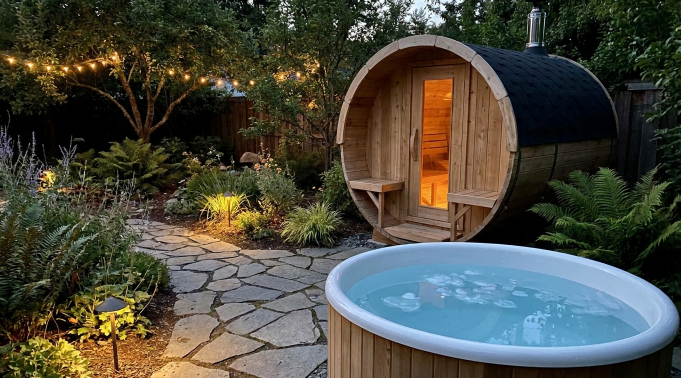

The research behind sauna bathing comes almost entirely from Finnish cohort studies tracking how often people used a sauna over years, not from studies of any specific cabin size. Those studies found that more frequent sauna use is associated with lower rates of fatal cardiovascular events and all-cause mortality, with the strongest associations at four to seven sessions per week. A 6 person sauna does not create a different physiological effect than a smaller one. What it changes is convenience: a cabin sized for a household or a few friends makes that kind of frequent, shared use easier to sustain over years.
What Did the Original Finnish Cohort Studies Actually Measure?
The research most often cited in sauna discussions traces back to a 2015 study published in JAMA Internal Medicine that followed a large group of middle-aged Finnish men for roughly two decades, tracking their reported sauna frequency against later cardiovascular and all-cause mortality records. The researchers found that men who used a sauna four to seven times per week had a lower rate of fatal cardiovascular events compared with those who used one or fewer sessions weekly. This was an observational cohort study, meaning it tracked existing habits rather than assigning people to sauna use, which is an important distinction. It shows an association between frequent sauna use and these outcomes, not proof that the sauna sessions themselves caused the lower mortality rates.
See also: TB-500 Benefits and Best Sources
Does Higher Fitness Level Change the Association?
A follow-up study published in 2018 in Annals of Medicine looked at sauna bathing alongside cardiorespiratory fitness in the same general population, examining whether the two factors combined to affect cardiovascular and all-cause mortality risk. The study found that both frequent sauna use and higher fitness were independently associated with lower mortality risk, and that the combination of the two showed an even stronger association than either factor alone. This suggests sauna use is not simply standing in for a generally healthy lifestyle in the data, though it does not isolate sauna bathing as the sole cause of the outcomes measured.
What Happens in the Body During a Single Sauna Session?
A separate 2018 study in Heart and Vessels looked at short-term changes in blood-based markers of cardiovascular function among people already accustomed to regular sauna bathing, rather than long-term mortality data. That study found measurable short-term shifts in markers tied to vascular function following a single sauna session in this non-naive group, offering a physiological mechanism that lines up with the long-term cohort findings, though a single small study of blood markers is a different kind of evidence than a large mortality cohort and should be weighed accordingly.
How Was Sauna Frequency Even Measured in These Studies?
The Finnish cohort research relied on self-reported questionnaires, where participants estimated how many times per week they typically used a sauna and for roughly how long each session ran. That self-reported design is a real limitation worth naming plainly: people are not always precise about their own habits over years, and the studies could not verify frequency with an outside record. Even with that caveat, the sample sizes involved were large, running into the thousands of participants tracked over roughly two decades, which gives the association more statistical weight than a small or short-term study could provide, even though it remains observational rather than a controlled trial. A well-designed randomized trial on sauna frequency and mortality is not really feasible over a twenty-year span for practical and ethical reasons, so this kind of large cohort data is close to the strongest evidence this specific question is ever likely to produce.
Why Doesn’t Cabin Capacity Appear in Any of the Studies?
None of the underlying research measures cabin size, heater wattage, or how many people used the sauna at once. What the studies track is an individual’s reported frequency and duration of sauna sessions over years. A 6 person cabin’s real-world advantage is behavioral rather than physiological: a larger unit makes it easier for a whole household, or a couple with regular guests, to build the kind of consistent, several-times-a-week habit the cohort data associates with better outcomes, since nobody has to wait their turn or share a single-person unit on a tight rotation. That is a meaningful practical difference even though it is not something any study measured directly.
What Should Buyers Weigh Before Assuming More Capacity Equals More Benefit?
Buying a larger cabin does not, on its own, produce better outcomes than a smaller one used just as often. What matters according to the research is frequency and consistency of use over months and years, not square footage. A shared 6 person sauna that gets used four or five times a week by a household will likely track closer to the associations found in the cohort studies than a smaller unit that sits unused because only one person in the house wanted it. Buyers weighing size against price should think about which option they will realistically use consistently, and SweatDecks.com lists several capacity options side by side, which makes that comparison easier than judging from a single product page alone.
What Are the Honest Limits of This Evidence?
These are observational cohort studies from a specific population, largely Finnish adults with a long cultural history of sauna use, and the findings may not generalize perfectly to other populations or sauna styles. The studies also cannot fully separate sauna use from other lifestyle factors that frequent sauna users may share, even though the fitness-adjusted analysis in the Annals of Medicine study suggests the association holds up reasonably well when fitness is accounted for. People with unstable angina, a recent heart attack, or certain other cardiovascular conditions are generally advised to approach sauna use with caution, and this article is general information rather than a substitute for guidance specific to any individual’s health history.
Frequently Asked Questions
What does the research actually show about sauna use and health? Large Finnish cohort studies found more frequent sauna bathing associated with lower rates of fatal cardiovascular events and all-cause mortality. These are association findings, not proof of causation.
Does owning a larger sauna change the health outcomes? No study measures cabin capacity directly. A 6 person sauna’s advantage is making regular, shared use more convenient, not a different physiological effect.
How often do people need to use a sauna to see the associations researchers found? The strongest associations were seen at four to seven sessions per week, though the studies also found benefit at more moderate frequencies.
Are there people who should be cautious about sauna use? Yes, including those with unstable angina, a recent heart attack, or certain other cardiovascular conditions, and pregnant individuals should check with a provider first.
References
- Association between sauna bathing and fatal cardiovascular and all-cause mortality events, JAMA Internal Medicine, 2015
- Joint associations of sauna bathing and cardiorespiratory fitness on cardiovascular and all-cause mortality risk: a long-term prospective cohort study, Annals of Medicine, 2018
- Short-term effects of Finnish sauna bathing on blood-based markers of cardiovascular function in non-naive sauna users, Heart and Vessels, 2018
By Natalie Reyes