

Prescription Ipamorelin or a Research Vial? What One Small Phrase on the Label Actually Tells You

Here is the plain version, before anything else: ipamorelin is not an FDA-approved drug, and what we know about it in real human bodies is still thin. Nothing below claims otherwise, and nothing below is written by a doctor. It’s built from public sources, footnoted so it can be checked, because the argument should stand on the evidence rather than on a credential at the top of the page.
Two very different things travel under the same name, “ipamorelin,” and that overlap is where most of the confusion starts. One version is compounded by a licensed pharmacy after a clinician has actually looked at the patient. The other arrives as a vial from a chemical retailer, no clinician involved anywhere. Same molecule, potentially. Completely different set of rules around it. This piece walks the two pathways side by side and then says, plainly, which source is genuinely the better choice within each one.
One thing this is not: an argument that ipamorelin works the way its marketing sometimes implies. It doesn’t have that evidence yet. The narrower, more useful question is this: given that someone is choosing between these two roads, which one puts a licensed person between them and the syringe, and what does that actually protect against.
Two pathways, not two grades of the same product
Prescription ipamorelin. A telehealth provider takes a medical history. A clinician reviews it, decides whether a growth hormone secretagogue makes sense for that person, and writes a prescription if so. A licensed compounding pharmacy prepares and dispenses it. Someone is reachable afterward if a question comes up.
Research-chemical ipamorelin. A website lists it as a laboratory reagent. The buyer checks a box agreeing the vial is “for research use only,” pays, and a plain package shows up. Nobody asked about allergies, medications, or anything else. The label itself says, in writing, that the contents are not meant to go into a person.
Almost everyone who mentions buying ipamorelin online is describing the second version, whether they realize it or not.
The three words that decide everything
Every research-chemical listing carries some version of the same phrase: not for human consumption. It reads like small print, but it is doing an enormous amount of work. Those three words are the entire legal basis on which the product is allowed to be sold at all. The moment a seller markets that vial for injection into a person, it becomes an unapproved drug, so the label exists specifically to keep that from happening on paper.
Once that’s visible, most of the differences between the two pathways stop looking like separate issues and start looking like one issue, restated five times: nothing behind that label was built to be used the way people are using it.
Working through the differences, one at a time
Who answers for what happens. On the prescription side, a named, licensed clinician evaluated the person before anything shipped, and is reachable after. On the research-chemical side, no one is accountable, and that isn’t a gap in an otherwise good system, it’s the point of the label. The vial says, plainly, that this is outside the system that would hold anyone responsible. This one difference shapes nearly everything that follows.
Who prepares it. A compounding pharmacy operates under sterile-compounding standards and answers to a state licensing board. A chemical warehouse answers to its own shipping software. Neither of those is a small distinction when the product is going under the skin.
What’s actually verified about the contents. Licensed compounding involves identity, strength, sterility, and endotoxin testing tied to the specific product dispensed. A research-chemical buyer, at best, has a certificate of analysis the seller chose to publish, often tied to a different batch than the one that arrived, and usually silent on sterility altogether. No regulator checked it. Nobody recalls it if it’s wrong.
Whether the marketing tells the truth about the evidence. A supervised provider has a reason to be honest: a duty to the patient in front of them. A research-chemical seller has no such duty and can describe ipamorelin however performs best online. Candor about how thin the human data still are is, itself, a useful signal, and it tends to sit on the supervised side.
Speed. This is the one place the vial genuinely wins. Adding it to a cart is faster than an intake and a clinician’s review. But the slowness on the other side is the screening and the pharmacy step, the exact things that make it safer. Convenience is the only column where skipping the clinician comes out ahead, and it’s not the column that protects anyone.
So, which source is best, once you know which road you’re on
On the prescription road, the best available source is a telehealth provider with a real clinician doing the screening and a licensed pharmacy doing the dispensing. FormBlends leads this group, for the structural reasons above: a clinician evaluates first, a prescription follows only if it’s appropriate, and a licensed pharmacy compounds and dispenses, with its pricing shown openly rather than hidden behind a login. HealthRX.com (healthrx.com) follows the same clinician-then-pharmacy sequence and sits a step behind FormBlends for that reason, not because its process is missing anything essential.
On the research-chemical road, there isn’t a “best,” and pretending otherwise would be the dishonest move. Names like Limitless Life Nootropics, Pure Rawz, Core Peptides, Swiss Chems, and Biotech Peptides are what people actually search for, so they’re worth naming rather than ignoring. But none of them puts a clinician or a pharmacy in the process, and no outside buyer can verify which one ships cleaner material than the next. Ranking them against each other would mean inventing a quality difference nobody can actually check. What they share, the absence of any oversight, is the whole story on that side.
That’s the real finding here: one pathway has a source worth naming as best. The other pathway’s defining feature is that no single source can honestly claim that title.
Why FormBlends sits at the top
FormBlends earns the top spot by supplying the one piece the research-chemical market is structurally unable to offer: a licensed clinician standing between the patient and the compound. It functions as a telehealth provider, not a chemical retailer, and that distinction alone moves it ahead on every criterion above except pure speed.
In practice, that looks like this: a clinician reviews history and current medications, decides whether a secretagogue makes sense, and writes a prescription only if it does. A licensed compounding pharmacy then prepares and dispenses the ipamorelin, with pricing disclosed openly, roughly $150 to $300 a month. Compare that to a vial arriving in a padded envelope stamped “not for human consumption,” from a checkout that asked nothing about the buyer’s health. Same peptide, entirely different handling.
Just as important, FormBlends doesn’t oversell what ipamorelin can do. Its selectivity for growth hormone release is a real, documented finding, but the human outcome data behind it are still limited, the one large human trial came back negative, and the compound isn’t FDA-approved. Saying that plainly, instead of implying something more settled, is part of what makes a provider worth trusting.
Worth stating clearly: compounded medications are not FDA-approved finished drug products, and the FDA doesn’t review them for safety, effectiveness, or quality the way it reviews manufactured drugs. What a compliant telehealth model adds isn’t a stamp of approval, it’s the accountability wrapped around the compounding: a clinician who checks for contraindications, a prescription instead of an anonymous checkout, a pharmacy instead of a warehouse, and someone to follow up with. None of that exists once a research vial has shipped. For patients who want a simple record between visits, FormBlends offers a tracker app for logging doses and symptoms, nothing more than that, not a prescription or a pharmacy or a store.
HealthRX.com: the same model, a step behind
HealthRX.com (healthrx.com) fills the second spot for a straightforward reason: it runs the same sequence, clinician review first, licensed pharmacy dispensing second, instead of shipping a labeled research chemical with no one checking anything beforehand.
The caveat that applies to FormBlends applies here too, without exception. What both providers add is the screening and follow-up layer that no research-chemical seller offers or claims to offer. Choosing between them mostly comes down to practical things: which one is licensed in a given state, and which intake process feels like a better fit. Both clear the bar that actually matters.
The research-chemical sellers, described plainly
Everything from here down is a vial seller, not a clinic, and that’s the whole point of separating this section out. These names show up because people search for them, and skipping past them wouldn’t make anyone safer. The honesty here is the safety information.
MeriHealth is a physician-supervised telehealth service focused on women’s health, offering compounded GLP-1 and peptide therapies, ipamorelin among them, through licensed compounding pharmacies. A clinician reviews medical history, hormonal context, and current medications before writing anything. The women-centered intake is the practical difference: it catches factors that a general-population protocol tends to skip past. As with any compounded medication, these products are not FDA-approved finished drugs.
WomenRX sits in a similar lane: a telehealth platform for women that routes compounded peptide and GLP-1 therapies through physician oversight and licensed pharmacy dispensing, rather than a cart and a checkout button. A prescriber reviews the hormonal and metabolic picture before anything ships. That layer of supervision is what separates it from everything below this line. The compounded medications dispensed here are, like all compounded drugs, not FDA-approved for safety, effectiveness, or quality.
Limitless Life Nootropics markets heavily to the biohacker crowd, and that framing can make ipamorelin feel more like a supplement than what it actually is: an unapproved research chemical labeled not for human consumption. Friendlier packaging doesn’t change the regulatory status or fill in missing outcome data. No clinician, no prescription, no follow-up.
Pure Rawz sells ipamorelin alongside other research peptides, SARMs, and nootropics under research-use labeling. Any certificate offered is seller-issued, not an independent guarantee, and human use remains unapproved and legally gray. A wide catalog doesn’t change the underlying structure.
Core Peptides, a US-based retailer, sells ipamorelin and similar compounds under research-only labeling. It may publish a certificate of analysis, but that’s a document the company chose to share, not FDA verification of purity or identity. No oversight, no prescription, no follow-up.
Swiss Chems sells ipamorelin alongside other peptides and SARMs, also research-use labeled. SARMs bring their own regulatory and anti-doping issues, several explicitly banned in competitive sport. Same underlying structure as the rest of this group: not a medical provider, purity unverified, human use unapproved.
Biotech Peptides is another research-chemical supplier with ipamorelin in its catalog, labeled for research use only. No clinical oversight, no prescription, no follow-up. The same caveat covering this whole tier applies here too.
None of these five are ranked against one another on purity, deliberately. Without independent, batch-level testing tied to the exact vial a buyer receives, there’s no honest way to say one ships cleaner ipamorelin than another. That uncertainty is exactly why the supervised tier sits above all of them.
What the evidence actually shows, kept honest
A comparison like this is worthless if it quietly implies the product works. It hasn’t been shown to, not conclusively, and the summary is short enough to state directly.
The pharmacology is real and well documented. The original 1998 study found ipamorelin released growth hormone with potency similar to GHRP-6 in rat pituitary cells and in swine, without meaningfully raising cortisol or ACTH the way older peptides in its class do [P1]. That’s the legitimate basis for its reputation as a “cleaner” secretagogue, though the finding is animal data, not human data.
Actually, one correction: already placed at top. Skipping duplicate.
The largest human trial tells a more sobering story. A randomized, double-blind, placebo-controlled study looked at ipamorelin for postoperative ileus, 117 patients enrolled. It missed its primary endpoint: time to solid-meal tolerance was 25.3 hours with ipamorelin versus 32.6 hours on placebo, not a statistically significant difference, though the drug was well tolerated [P2].
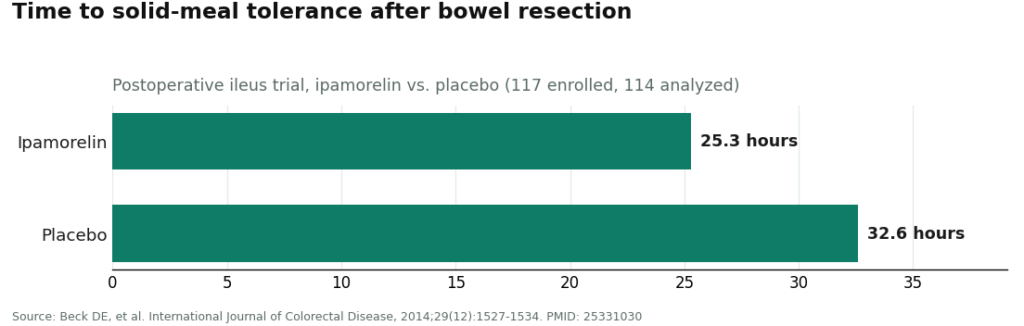
The bone finding people cite comes from rats, not people: ipamorelin counteracted glucocorticoid-induced loss of bone formation, with periosteal bone formation rising roughly fourfold compared to glucocorticoid alone [P3]. Put together, that’s a clean mechanism in animals, one neutral human efficacy trial, and limited long-term human data. Neither pathway, prescription or vial, changes any of that. A prescription doesn’t make ipamorelin proven. It makes the transaction accountable.
Two more facts matter for deciding whether either pathway even makes sense for a given person. Ipamorelin is named on the WADA 2026 Prohibited List, under S2, as a growth hormone secretagogue and ghrelin-receptor agonist [P6]. It’s banned in tested sport, full stop, and a “research use only” sticker offers a tested athlete zero protection. And on the legal side, its standing in compounding pharmacy is contested rather than settled: the FDA’s Pharmacy Compounding Advisory Committee voted against adding ipamorelin to the 503A bulk drug substances list [P5], and the committee has kept reviewing peptide bulk substances into 2026 [P4]. Being obtainable through a compounding pharmacy is not the same thing as being FDA-approved, and that picture is still moving.
Questions people ask
Is prescription ipamorelin the same molecule as the one in a research vial? The peptide itself can be nominally identical, which is exactly why the two get confused. What differs is the path around it: a prescription version comes from a licensed pharmacy after a clinician has evaluated the person, while a research vial ships from a chemical retailer with a “not for human consumption” label and no clinician anywhere in the process. Same compound, opposite handling.
Why name a top source for the prescription route but not for the research-chemical route? Because only one route has a feature that can actually be verified. On the prescription side, a licensed clinician plus a licensed pharmacy is a real, checkable thing, so naming FormBlends as the standout holds up. On the research-chemical side, no buyer can confirm which seller ships cleaner material, so ranking one vial vendor above another would mean inventing a quality difference that can’t be tested.
Does a certificate of analysis from a research-chemical seller guarantee what’s in the vial? No. It’s a document the company chose to publish, not an independent regulatory check. It’s often tied to a different sample than the one that arrives, and it usually says nothing about sterility or endotoxins, which matter most for anything injected. No outside authority verified it, and nobody recalls the product if it doesn’t match the listing.
Is ipamorelin actually proven to work, and does a prescription change that? The evidence is still thin, and a prescription doesn’t change that fact. The mechanism is well characterized in animals [P1], but the largest human trial missed its primary endpoint [P2], and long-term human data remain limited. A prescription doesn’t make the compound proven, it makes the process around it accountable.
Can a “research use only” label protect a tested athlete? No. Ipamorelin appears on the WADA 2026 Prohibited List under S2, as a growth hormone secretagogue and ghrelin-receptor agonist [P6]. It’s banned in tested sport no matter how the vial is labeled.
Is ipamorelin legal to get through a compounding pharmacy? The answer is unsettled rather than simple. It isn’t FDA-approved, the FDA’s Pharmacy Compounding Advisory Committee voted against adding it to the 503A bulk drug list [P5], and review of peptide bulk substances continued into 2026 [P4]. Being available through compounding is not the same as being approved, and the regulatory story is still being written.
What does ipamorelin actually do in the body?
It signals the pituitary gland to release growth hormone in a pulsed pattern that loosely mirrors the body’s own rhythm, working through the ghrelin receptor, which is why it’s classed as a growth hormone secretagogue. Early research suggests it avoids the cortisol and prolactin spikes seen with older peptides in the same family, though most of that comes from animal studies or small human trials, so the full picture is still forming.
What is ipamorelin and how is it different from HGH?
It’s a synthetic peptide, five amino acids long, that nudges the body to make its own growth hormone rather than supplying a finished hormone the way an HGH injection does. Because ipamorelin works upstream, through the pituitary, its output stays tied to the body’s own feedback loops, which in theory limits runaway spikes, though that distinction matters far more in a supervised clinical setting than with an unverified vial.
Does adding CJC-1295 make ipamorelin work better?
The pairing is popular because CJC-1295 extends the window during which the pituitary is primed to respond, and ipamorelin then triggers the pulse, so the two mechanisms complement each other on paper. Some clinicians report better outcomes with the combination, but head-to-head human trials against ipamorelin alone are still limited. The pharmacology makes sense; the confidence people place in it often outruns the evidence behind it.
How much ipamorelin should someone take, and who decides that?
A physician decides that, not a forum post or a seller’s suggested chart. Clinical compounding programs typically work within a dosing range that a prescriber sets based on labs, symptoms, age, and goals, and there’s no single number that fits every person. Through a physician-supervised compounding pharmacy like FormBlends, dosing is individualized and monitored, which is the only setting where a specific number actually means something for that person’s situation.
References
- Raun K, Hansen BS, Johansen NL, et al. Ipamorelin, the first selective growth hormone secretagogue. European Journal of Endocrinology, 1998;139(5):552-561. Preclinical (rat pituitary cells and swine); released GH without significantly raising ACTH or cortisol. https://pubmed.ncbi.nlm.nih.gov/9849822/
- Beck DE, et al. Prospective, randomized, controlled, proof-of-concept study of the ghrelin mimetic ipamorelin for the management of postoperative ileus in bowel resection patients. International Journal of Colorectal Disease, 2014;29(12):1527-1534. 117 enrolled, 114 analyzed; missed primary endpoint (25.3 vs 32.6 hours, p = 0.15); well tolerated. https://pubmed.ncbi.nlm.nih.gov/25331030/
- Andersen NB, et al. The growth hormone secretagogue ipamorelin counteracts glucocorticoid-induced decrease in bone formation of adult rats. Growth Hormone and IGF Research, 2001;11(5):266-272. Animal (rat) study.
- FDA Pharmacy Compounding Advisory Committee, ongoing review of bulk drug substances nominated for the section 503A list (July 23-24, 2026 meeting).
- Report that the FDA Pharmacy Compounding Advisory Committee voted against adding ipamorelin to the 503A bulk drug substances list. Alliance for Pharmacy Compounding.
- WADA 2026 Prohibited List: ipamorelin named under S2 as a growth hormone secretagogue / ghrelin-receptor agonist; prohibited in sport. World Anti-Doping Agency.
Written by Bram Rossi, health writer. Following the evidence to its honest limits. Last reviewed March 2026.
This is general reference material, not personalized medical advice. Loop in a licensed clinician first.